Be yourself; Everyone else is already taken.
— Oscar Wilde.
This is the first post on my new blog. I’m just getting this new blog going, so stay tuned for more. Subscribe below to get notified when I post new updates.
Be yourself; Everyone else is already taken.
— Oscar Wilde.
This is the first post on my new blog. I’m just getting this new blog going, so stay tuned for more. Subscribe below to get notified when I post new updates.

The final design to use on our outfit

Using a white t-shirt as the shirt


Using newspaper as the prototype of the dress or outfit.


Prototype mask by using papers as the mask and draw the emojis also using newspaper as the strap.

A stack of banknotes with wings. Chat partner was on shopping tour and spent a lot. The money just flies away.

A tightly filled moneybag with dollar sign. Used very often in well-known comics, such as those of Scrooge McDuck or the Beagle Boys. Caution! If the emoji is used, the conversation is about money.

The dollar sign emoji show the US money currency and means wealth or people who have money.

Smiley has dollar signs in its eyes, the tongue is a banknote. Could have won something or is sensing a financial chance. Implicates a sense of wealth.

Mischievously grinning goblin smiley with small devil horns. Wants to cause trouble, is a real teaser or planning something ugly just now or just want your money.

Typical smiley face with open mouth and oval eyes. Is in a positive mood, shows its teeth and laughs cheerfully. Expresses enthusiasm: from a cheerful greeting to boundless joy.


Jasper Johns laid the foundation for the Pop art movement’s aesthetic embrace of commodity culture with his playfully subversive appropriation of common signs and products. He idea was rather than direct representation or abstraction, Johns made signs, like flags and targets, the main images in his works. The “things the mind already knows” were his ideal subject because of the host of varied meanings each carried with it. This fostered the perceptual ambiguity and semiotic play at the heart of his works. Jasper Johns laid the foundation for the Pop art movement’s aesthetic embrace of commodity culture with his playfully subversive appropriation of common signs and products. He quoted the gesturally evocative Abstract Expressionist brushstroke, using the idea of the artist’s mark as merely another symbol that enhanced the multiplicity of meanings and interpretations in his paintings. Through his use of shreds of newspaper, found objects, and even mass-produced goods like Ballantine Ale and Savarin Coffee cans, Johns erased the division between fine art and mass culture. This shifted modern art away from abstraction towards the consumer landscape of mid-20 century America that made pop art popular.

The False Start is Johns eschewed the nonverbal symbols of his earlier works, instead relying upon the building blocks of language to draw viewers into a dialogue with the painting. The change of subject matter was occasioned by Johns’ desire to move beyond his earlier targets and flags. As he noted, “The flags and targets have colors positioned in a predetermined way. I wanted to find a way to apply color so that the color would be determined by some other method.” By focusing on colors and the words that represent them, Johns abstracted each, removing the traditional associations that accompanied them. Rather than hand-paint each letter, Johns used a store-bought stencil – a readymade method by which he could create an image without revealing the trace of the artist’s hand. He stenciled the words that denote colors on top and underneath the various layers of paint as he worked. Johns transformed the words into objects by rendering most in colors unrelated to those which they verbally represented – “RED” appears painted in bright orange in the center of the canvas. Johns revealed the dissonance between the words and the colors, shifting their function from designation to a mere assembly of symbols, ripe for reconsideration.

Pop Art is meant to be fun. Pop Art began in the 1950s, but became very popular in the 1960s. It started in the United Kingdom, but became a true art movement in New York City with artists like Andy Warhol and Jasper Johns. Pop Art uses images and icons that are popular in the modern world.


It took me and Shawn 3 weeks to finish the stick Colosseum and happy what we got and how it looks
The colosseum was build by the Vespasion in the year 70 ED and was finish in the year 82 ED but the Domintian completed it. It was build as a form of entertainment that see as a theatre of crime after the Domintian took over. So the people who were throw in there had to fight in the colosseum as entertainment. The people who fought in there were not all slave or people capture after a war. Some of them wanted to fight because wanted glory.

The building form is a high, four-storey, massonry oval that looks likes a very big bowl slung from the outside rings of unmade barrel vaults. The seat ran all over caveae, For the emperor, the senate and other privileged persons there were special tribunals called suggest that was nicer and more luxury to seat down. It was found 50 yard line or at the bottom of the colosseum that you can see all the fights. Women and the slave were only allowed to seat at the most top that was the cavea summa because they were segreated by the people. But those who were the upper class can seat at the middle and is call the suggesta.
Balsamaria, or ointment jars, were carried to the baths filled with precious unguents for use there. They have been found with strigils, or scrapers, further supporting their function as containers for oil. Applying oil and then scraping it off with a slightly curved blade-like strigil was a common part of the bathing process. Balsamaria were produced in the first three centuries of the Roman Empire in a variety of forms, including busts and animal shapes. Scholars believe that bronze vessels of this type are thought to have been used as oil containers specifically by athletes. The scenes of wild beasts rendered in low relief are thought to refer to the stages hunts that were held in amphitheaters and were an integral part of athletic spectacles in Ancient Rome.


Red was probably one of the primary colors of the interior walls in the houses of the Roman cities. Much of the earliest luster has faded away which is why several of the paintings were taken off the city by the archaeologists in a due course of time. A number of pieces with red colorings inside the convention are muted and at times even distorted with mauve.However, this well-maintained painting has somehow held on to all its originality of color that it possessed from the time when an unidentified artist sketched it in the 1st Century AD.
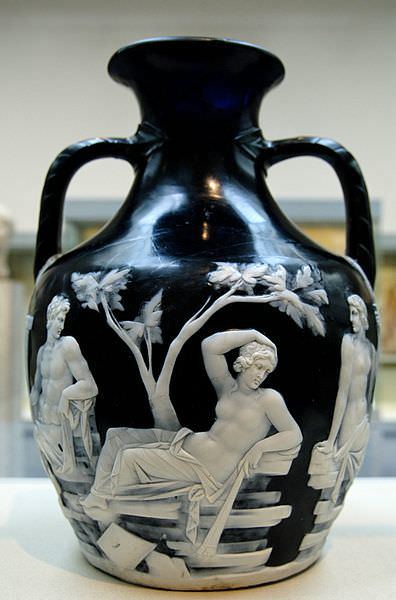
The Portland Vase is a Roman two-handled glass amphora dating to between the second half of the 1st century BCE and the early 1st century CE. The vase has a cameo-like effect decoration which perhaps depicts the marriage of Peleus and Thetis from Greek Mythology. The vase is 24.5 cm in height and 17.7 cm in its maximum width. The vase was made by blowing the dark cobalt blue coloured glass covered with a layer of opaque white cased glass. Large areas of the white glass were then removed to reveal the under layer of blue. The Portland Vase is a Roman two-handled glass amphora dating to between the second half of the 1st century BCE and the early 1st century CE. The vase has a cameo-like effect decoration which perhaps depicts the marriage of Peleus and Thetis from Greek Mythology.

The by a bearded head or its horns, one under each handle. The vase at front has four image which include a young man leaving a shrine in the countryside and wearing a cloak. The man holds the arm of a semi-naked woman sitting on the ground preoccupied with stroking an animal resembling a snake. Above the woman is the flying figure of Eros with his customary bow and a torch in his right hand. On the right is a bearded male standing between two trees and depicted in a contemplative mood with his chin resting on his hand. At the back of the he vase shows three image all taking a rest on rocks with a background of a single tree. On the left is a young male next to a pillar, whilst in the centre is a young woman with her arm raised to her head and holding a torch which hangs down to the ground. On the far right is another half-dressed woman who holds a sceptre or staff in her left hand. In the 1845 CE disaster struck when the vase was smashed to pieces in the British Museum.
This is an example post, originally published as part of Blogging University. Enroll in one of our ten programs, and start your blog right.
You’re going to publish a post today. Don’t worry about how your blog looks. Don’t worry if you haven’t given it a name yet, or you’re feeling overwhelmed. Just click the “New Post” button, and tell us why you’re here.
Why do this?
The post can be short or long, a personal intro to your life or a bloggy mission statement, a manifesto for the future or a simple outline of your the types of things you hope to publish.
To help you get started, here are a few questions:
You’re not locked into any of this; one of the wonderful things about blogs is how they constantly evolve as we learn, grow, and interact with one another — but it’s good to know where and why you started, and articulating your goals may just give you a few other post ideas.
Can’t think how to get started? Just write the first thing that pops into your head. Anne Lamott, author of a book on writing we love, says that you need to give yourself permission to write a “crappy first draft”. Anne makes a great point — just start writing, and worry about editing it later.
When you’re ready to publish, give your post three to five tags that describe your blog’s focus — writing, photography, fiction, parenting, food, cars, movies, sports, whatever. These tags will help others who care about your topics find you in the Reader. Make sure one of the tags is “zerotohero,” so other new bloggers can find you, too.
 History Arts & Media